
Railroad crossings demandyour full attention.
Learn what signs and signals mean, how to avoid becoming trapped on the tracks, what to do during an emergency, and where to report a warning-device problem or recurring blocked crossing.
For injury, fire, collision, or another life-threatening emergency.
Call 911 →Vehicle on tracksGet Out. Get Away.Then locate the blue-and-white ENS sign and call the railroad responsible for the crossing.
Emergency Steps ↓Signs & signalsKnow What They MeanUnderstand crossbucks, flashing lights, gates, ENS signs, and multiple tracks.
Crossing Basics ↓Non-emergency reportBlocked Crossing PortalReport a recent recurring or extended blockage to the Federal Railroad Administration.
Open FRA Reporter ↗A familiar crossing is still an active railroad.
Freight trains do not operate on a public timetable. A train can approach at any hour, on any track, and from either direction.
Highway users and pedestrians must yield because a train cannot steer away and can require a mile or more to stop under typical freight-train conditions.
Cross only at a designated public crossing, obey every sign and signal, look in both directions, and enter only when your entire vehicle can completely clear the tracks.
Signs and devices communicate different instructions.
Active warning devices indicate an approaching or occupying train. Passive signs identify the crossing and require road users to look, listen, and yield.
Marks the railroad crossing and should be treated as a yield sign. Trains have the right of way.
A train is approaching or occupying the crossing. Stop and remain stopped until the warning devices stop and the crossing is clearly safe.
Lists the railroad emergency telephone number and the crossing's unique U.S. DOT identification number.
One train can hide another. Wait until warning devices stop and you can clearly see that all tracks are safe to cross.
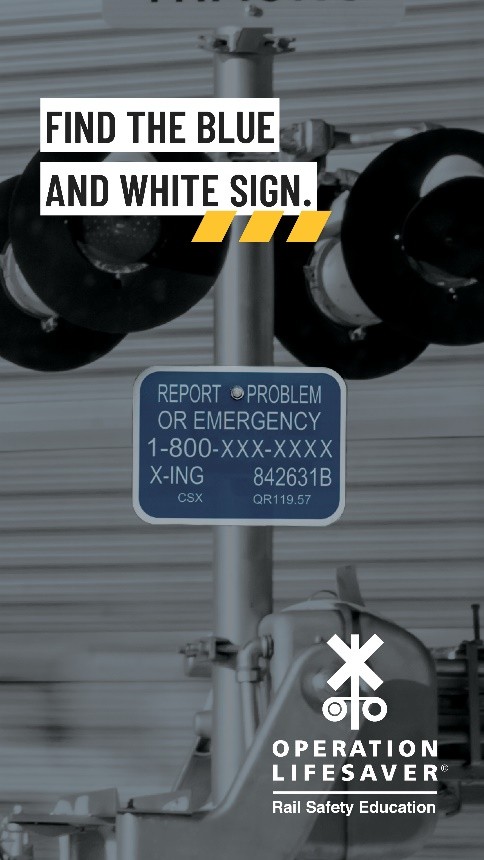
The blue-and-white sign identifies the crossing and railroad.
Every highway-rail grade crossing has an Emergency Notification System sign containing the railroad emergency contact and the U.S. DOT crossing number. Use it for an urgent safety problem at that location.
When you call, provide the crossing number exactly as it appears on the sign and describe the vehicle, obstruction, warning-device problem, collision, or other issue.
Get out. Get away. Find the blue-and-white sign.
Do not remain in the vehicle while trying to restart it. Evacuate everyone and move far away from the tracks.
Search the question or filter by topic.
These answers summarize public rail-safety guidance. Professional and regulated drivers must also follow applicable laws and employer procedures.
01Do freight trains run on a set schedule?
No. Freight trains can operate at any time, on any track, and in either direction. Always expect a train—even if the crossing is usually quiet.
02Why can a train not stop as quickly as a vehicle?
A train has far more mass than a highway vehicle, and steel wheels provide less friction on steel rail than rubber tires do on pavement. A freight train at highway speed may require a mile or more to stop.
03How far should I stop from the nearest rail?
Stay behind the marked stop line. When no stop line is present, Operation Lifesaver advises stopping at least 15 feet from the nearest rail. Regulated vehicles may have additional requirements.
04What do flashing red lights mean?
Flashing red lights warn that a train is approaching or occupying the crossing. Stop and wait until the lights stop flashing and it is clearly safe to cross.
05Can I drive around a lowered crossing gate?
No. Never drive around, under, or between lowered gates. Remain stopped until the gates are fully raised, the lights stop flashing, and the crossing is clearly safe.
06What if the lights begin flashing after I have already started across?
Continue moving and clear the crossing. Do not stop, reverse, or remain on the tracks.
07Why might the gates stay down after one train passes?
Another train may be approaching on a second track, or operating conditions may continue to activate the warning system. Wait until the lights stop and the gates are fully raised.
08What is a passive crossing?
A passive crossing has no flashing lights or gates. It may have a crossbuck, yield sign, stop sign, pavement markings, or advance warning signs. Slow down, look, listen, and be prepared to stop.
09What does a crossbuck sign mean?
A crossbuck marks the railroad crossing and should be treated as a yield sign. Trains have the right of way.
10What should I do if my vehicle is stuck or stalls on the tracks?
Get everyone out immediately and move far away from the tracks. Call the railroad using the blue-and-white ENS sign and provide the U.S. DOT crossing number. Call 911 for injury, fire, immediate danger, or when no ENS sign is available.
11What is the blue-and-white Emergency Notification System sign?
The ENS sign lists the railroad emergency telephone number and the crossing's unique U.S. DOT identification number.
12When should I call the ENS number?
Use it for a vehicle or object on the tracks, a warning-device malfunction, a collision, damaged equipment, or another urgent safety problem at that crossing.
13What if I believe the gates or lights are malfunctioning?
Remain clear and do not assume the crossing is safe. Call the number on the ENS sign and provide the crossing ID. Call 911 for immediate danger or injury.
14How do I avoid getting trapped on the tracks in traffic?
Do not enter unless there is enough room on the far side for your entire vehicle to clear every track. If it will not fit, do not commit to the crossing.
15What should drivers of low-clearance vehicles do?
Plan the route in advance and watch for low-ground-clearance warning signs. Raised crossings can trap lowboys, trailers, buses, RVs, and some passenger vehicles. Use an alternate route if clearance is uncertain.
16Are professional drivers subject to additional crossing rules?
Yes. School buses, certain hazardous-material vehicles, passenger vehicles, and other regulated equipment may be required to stop and follow specific procedures. Drivers must follow applicable law and employer policies.
17Should I shift gears while crossing the tracks?
Avoid shifting while on the crossing. Select a gear that allows the vehicle to cross completely without stopping or changing gears.
18Can I walk along railroad tracks or use them as a shortcut?
No. Tracks, bridges, tunnels, yards, and railroad equipment are private property and active operating areas. Cross only at a designated public crossing.
19Where should pedestrians, bicyclists, and mobility-device users cross?
Use only designated public crossings. Obey gates, lights, signs, and pavement markings, and remain alert for flangeway gaps, multiple tracks, and trains from either direction.
20Can I take photographs from railroad property?
No public access is implied. Photograph only from a lawful public location and review Ontario Midland's Visitor & Photography Policy before planning a visit.
21What is a quiet zone?
A quiet zone restricts routine horn sounding through a federal process. It does not mean trains are absent or that horns will never sound; locomotive engineers may still sound the horn when necessary for safety.
22How should I report a crossing blocked for an extended time?
Use the FRA Public Blocked Crossing Incident Reporter for a recent recurring or extended blockage. It is not for active emergencies.
23How can I identify a crossing or find its railroad contact?
Use the blue-and-white ENS sign or the FRA Rail Crossing Locator. Each public highway-rail crossing has a unique U.S. DOT crossing number.
24Can a community request an Operation Lifesaver presentation?
Yes. Operation Lifesaver provides free rail-safety presentations for many audiences, subject to volunteer availability.
Know the vehicle before committing to the crossing.
Commercial vehicles, buses, farm equipment, trailers, RVs, and hazardous-material movements may require additional planning and specific procedures.
Emergency, malfunction, or recurring blockage?
A general website contact form should never be the first action during an active crossing emergency.
Move to safety and call 911.
For injury, fire, collision, or immediate danger, call 911. When possible, also call the railroad using the ENS sign at the crossing.
Call 911 →Call the railroad using the ENS sign.
Use the emergency number on the blue-and-white sign and provide the U.S. DOT crossing number so the railroad can identify the exact location.
Learn About ENS Signs ↗Use the FRA Blocked Crossing Reporter.
The federal portal can be used for a recent recurring or extended blockage. It is not intended for an active emergency.
Open FRA Reporter ↗Learn more or request public rail-safety education.
Need crossing information, community education, or help planning authorized work nearby?
Contact Ontario Midland for non-emergency questions, planned work, contractor coordination, or public education. Do not use the general contact form for an active emergency.